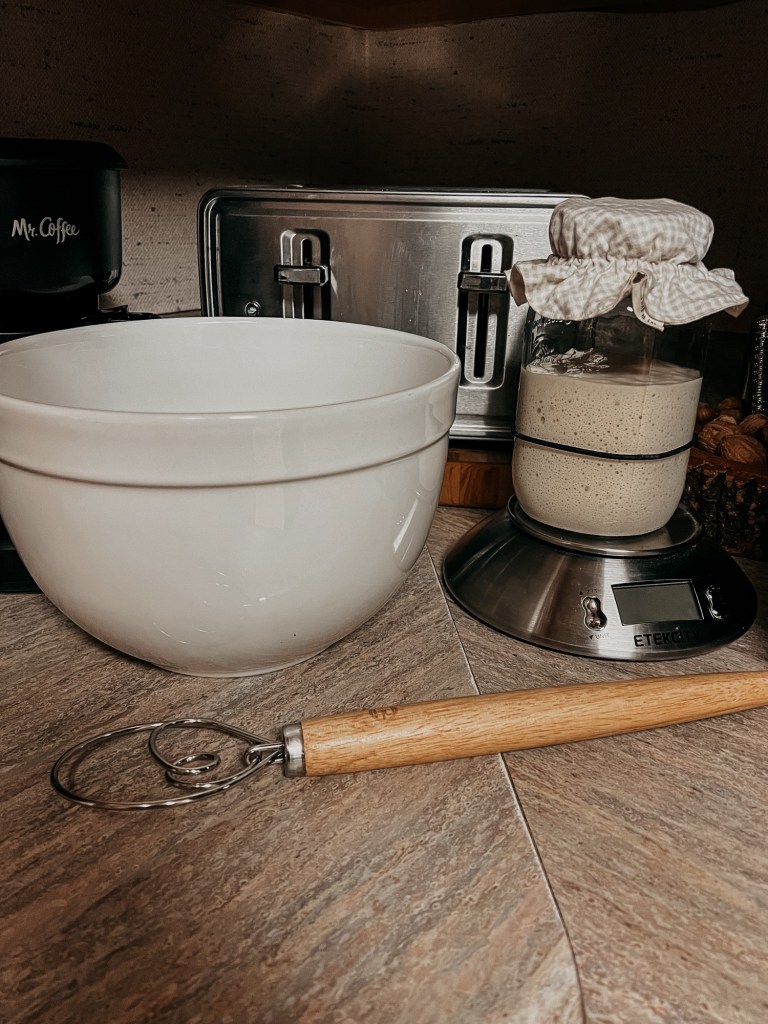
There’s something special about a bubbling jar of sourdough starter sitting on the kitchen counter, quietly working away, transforming the simplest ingredients into something full of life. When I first began my sourdough journey, I didn’t fully understand the beauty of it. It wasn’t trendy at the time, I just knew I wanted to bake bread the way generations before me had done—without packets of yeast, without shortcuts, just flour, salt, water, and time.
Now, keeping a sourdough starter feels like second nature, woven into the rhythm of my kitchen. But it wasn’t always that way. I remember the doubts in the beginning—Is it working? Why isn’t it bubbling? What if I kill it? Yet, as with so many things in this simple, slow life, I learned that patience is the key. Sourdough doesn’t rush, and neither should we.
If you’ve been wanting to start your own sourdough journey, I promise, it’s not as intimidating as it seems. You don’t need anything fancy—just flour, water, and a little faith in the process. Here’s how I made my starter and how I keep it alive.
Creating My Sourdough Starter
Like all good things, sourdough starts small. It begins as a simple mixture of flour and water, left to sit and wait while wild yeast and bacteria naturally begin their work. There’s no magic to it—just time and care.
What You’ll Need:
A clean glass jar (wide-mouth mason jar is ideal)
A kitchen scale
Organic, unbleached flour (I use King Arthur Organic Bread Flour)
Filtered or dechlorinated water (avoid tap water if possible)
A loosely fitted lid or a cloth jar cover
The Process:
Day 1: In a clean glass jar, mix 50g of flour and 50g of filtered water until well combined. The consistency should be like thick pancake batter. Cover loosely with a lid or cloth and set it in a warm spot (around 70-75°F is best). Now, wait 24 hours.
Day 2: Discard 80% of the starter (yes, it feels wasteful, but trust the process). Add 50g of fresh flour and 50g of water, stir well, and cover again. Let it rest another 24 hours.
Days 3-5: Repeat the same process—discarding 80% and feeding with 50g flour and 50g water once per day. You might start noticing tiny bubbles and a slightly tangy smell. If not, don’t worry. I like to put a rubber band where the top of the mixture is after I feed it so I can see how much it rises.
Day 6: If you’re seeing consistent bubbles and your starter looks a little livelier, you can start feeding it twice a day (morning and evening). If it’s still sluggish, continue feeding once a day and be patient.
Days 7-10: By now, your starter should be active, rising and falling predictably after each feeding. You’ll know it’s ready when it doubles in size within 4-6 hours of being fed. You can test its maturity with a simple float test—take a spoonful of starter and drop it into warm water. If it floats, it’s strong enough to bake with!
Once your starter is healthy and active, it’s officially mature and ready to leaven bread. You can now begin baking whenever it reaches its “peak” (when it has doubled in size after a feeding). If you’re ready to take the next step, check out my Traditional Sourdough Loaf Recipe for a simple, delicious way to use your starter. It’s a perfect beginner-friendly recipe!
Once it starts to collapse, that portion is considered discard, which can be used for pancakes, crackers, biscuits, and so many other recipes. My Simple Sourdough Discard Biscuits are an easy and delicious way to utilize your discard.
Keeping My Starter Alive
A sourdough starter is a living thing—it needs care and consistency to thrive. But once it’s well-established, it’s incredibly resilient. Some starters have been passed down for generations!
Daily Maintenance (for frequent bakers):
If I’m baking often, I leave my starter at room temperature and feed it once or twice a day (morning and evening if I want it extra active). I usually feed it in a 1:1:1 ratio of starter, flour, and water. If I’m only baking one loaf at a time, I typically use 50g of each and only feed once a day.
I also love using reusable mason jar covers to keep my starter covered while allowing airflow. Etsy has a wide variety for anyone looking for that option.
Long-Term Storage (for occasional bakers):
If I don’t plan to bake every day, I store my starter in the fridge. Before refrigerating, I put a mason jar lid on tightly to prevent mold from forming.
Over time, a layer of hooch (a dark liquid) may develop on top. This is completely normal! It’s just the starter producing alcohol as it ferments. You can either stir it in or pour it off before feeding.
When I’m ready to bake again, I take my starter out, let it warm to room temperature, and give a feeding or two before using it.
Reviving a Neglected Starter:
If I ever forget to feed my starter for a while (it happens!), I simply start feeding it consistently again. Even if it looks weak or smells extra sour, it can almost always be revived with a few good feedings.
The Beauty of Sourdough
Keeping a sourdough starter is more than just a baking technique—it’s a connection to the past, a daily practice in patience, and a reminder that the best things in life take time. There’s something deeply satisfying about seeing a loaf of bread rise in the oven, knowing that it came from nothing more than flour, water, salt, and time.
This little jar of bubbly, living culture has become part of my kitchen, part of my routine, part of the way I care for my family. It’s taught me to slow down, to trust the process, and to appreciate the simple, beautiful work of making food from scratch.
If you’ve been thinking about starting your own sourdough journey, I encourage you to take that first step. Mix the flour, add the water, and begin. It may not be perfect, but that’s the beauty of it. Every starter has its own personality, its own quirks, its own story.
And before long, you’ll find yourself in the rhythm of it—feeding, waiting, baking, sharing. Passing down something simple yet extraordinary, just as it’s been done for generations before us.

